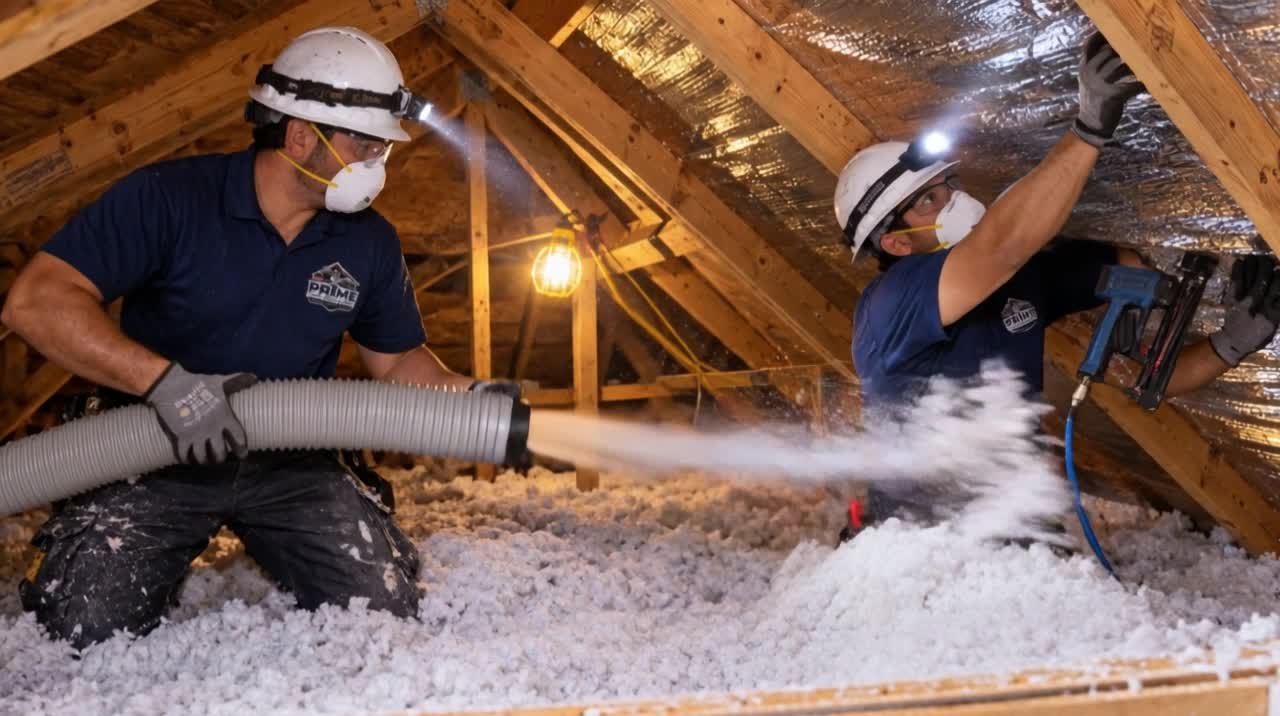
Not every old attic needs a full removal. Here's how to tell the difference between insulation that can be topped up and insulation that has to come out, with the honest answer on cost.
This is the question behind half the insulation quotes homeowners post online for a second opinion: "Company A says just blow new insulation on top for $1,800. Company B says remove everything first, $4,500. Who's right?"
Both can be. It depends entirely on what's up there now, and you can find out yourself in five minutes with a flashlight.
Insulation doesn't wear out. Clean, dry fiberglass from 1998 insulates exactly as well per inch as it did in 1998. If what you have is:
then adding new insulation on top to reach R-30 is the right answer, and anyone who tells you it all has to come out is selling you a bigger job. Topping up is a few hours of work. We do it all the time.
Insulation is a sponge for everything that happens in an attic over twenty years. It needs to come out when any of these is true:
Removal is the expensive, unglamorous part of the job. It's priced by square footage and by how bad it is — clean fiberglass vacuums out fast; rodent-contaminated cellulose that has to be bagged by hand does not. On a typical South Florida attic, removal roughly doubles the job compared to a top-up.
So when the two quotes are far apart, ask the cheaper company one question: "Did you go in the attic?" A lot of top-up quotes are written from the hatch. A lot of removal quotes are written by someone who crawled to the far eave and found the wet patch.
And ask the expensive company: "Show me why." A contractor recommending removal should have photos of the problem — the matting, the droppings, the staining — not just a sentence on the estimate.
| Line | What it should say |
|---|---|
| Removal | Square footage, what's being removed, where it's going. Priced separately so you can see it. |
| Sanitation | Product name. SDS available. |
| Air sealing | Included or not — it should be. Fire-rated sealant at flues. |
| Insulation | Brand, product, target R-value and installed depth. Not just "blown insulation." |
| Baffles | Count. Without them the new insulation blocks your soffits. |
| Verification | Depth markers and completion photos. |
If a quote is one line — "Attic insulation, $X" — you can't compare it to anything, and that's usually the point.
Clean and dry: top it up. Wet, flat or contaminated: it comes out. A contractor who can't tell you which one you have, with photos, hasn't earned the job yet. Our inspection is free, Joseph goes into the attic himself, and the report tells you which situation you're in — honestly, even when the answer is the cheaper one.

Owner, Prime Attic Solutions. 15+ years in South Florida attics. Still does every inspection himself.
The thermostat says 76 and the bedroom says 84. The AC never cycles off. Here's what's actually happening above your ceiling — and the order to fix it in.
7 min read · Read →Half the internet says it's the best thing you can do to a Florida attic. The other half says it's a scam that cooks your shingles. Both are wrong. Here's when it pays.
8 min read · Read →The exterminator says the rats are gone. The insulation they lived in for two years is still above your bedroom. Here's the honest answer on what has to happen next.
7 min read · Read →Free inspection. Written report the same day. Three honest prices. Open 7 days.