Homeowners ask whether radiant barrier is a scam, whether it cooks shingles, and whether it beats adding insulation. Straight answers for South Florida, with the numbers.
Search "radiant barrier worth it" and you'll find two camps that never agree. One side has a 20–30°F attic temperature drop and swears by it. The other side has a home inspector saying the payback is twenty years and a neighbor who was quoted $4,500 by a company that never showed up.
We install radiant barrier. We also talk people out of it every week. Here's how to tell which camp you're in.
Heat gets into your attic three ways. Conduction and convection are what insulation fights. The third — radiant heat — is the roof deck, at 150°F, glowing infrared straight down onto the top of your insulation like a broiler element. In a South Florida summer this is the largest share of the heat entering the attic.
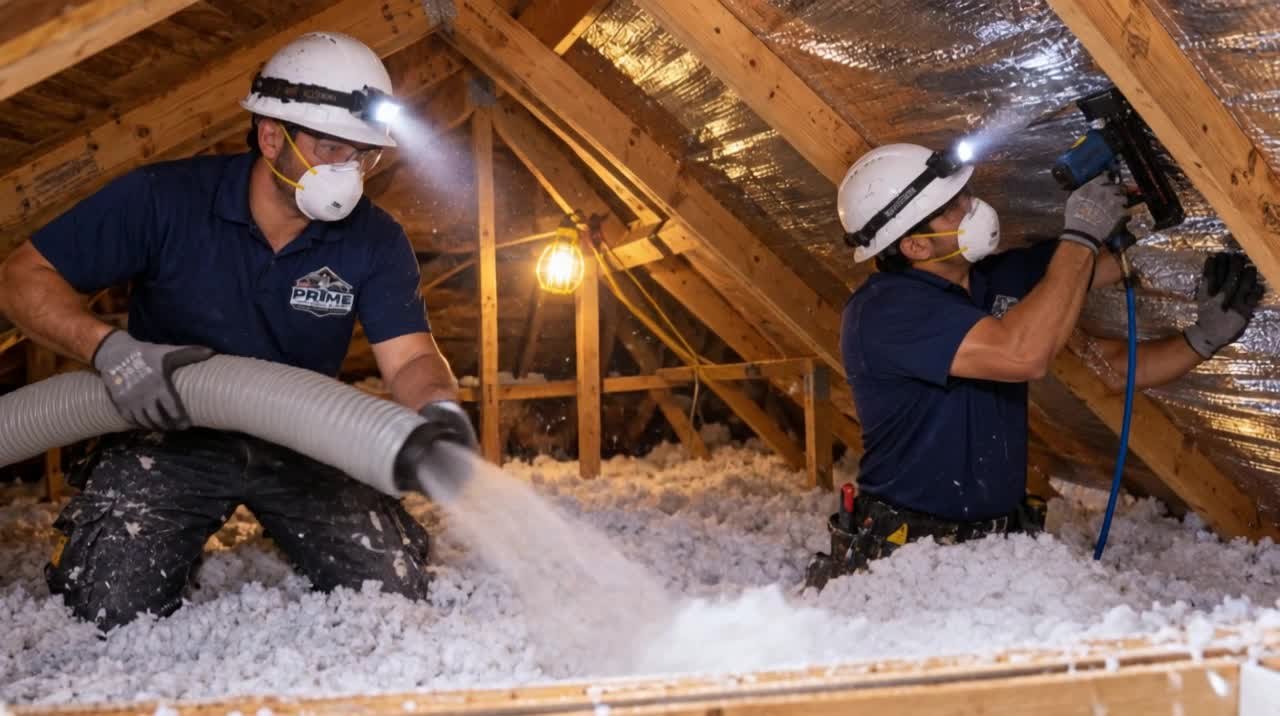
A radiant barrier is a reflective foil stapled to the underside of the rafters. It reflects most of that infrared back toward the roof instead of letting it soak into the insulation and the ducts. The result is an attic that runs 20–30°F cooler on a hot afternoon — and ducts carrying 55°F air through a 105°F attic instead of a 135°F one.
Doesn't it cook the shingles?
This one won't die. A rafter-mounted barrier raises roof-deck temperature by a few degrees — well inside what shingles are rated for, and roughly the difference between a black roof and a dark grey one. The product that causes problems is foil laid directly under the shingles on the sheathing, which we don't do and nobody should.
Isn't adding insulation a better use of the money?
If you're under R-30, yes — every time. Insulation first. A radiant barrier over R-11 is a beautiful roof on a house with no walls. We'll measure your depth before we ever quote a barrier.
The payback is twenty years, isn't it?
That number comes from retrofits priced at $4,000–5,000 on homes with modest bills. Two things changed. Perforated roll barrier installed on rafters is a fraction of that cost today, and South Florida bills aren't modest. Run your own number: take your summer FPL bill, estimate a 10% cooling reduction, and divide it into the quoted price. For most homes with ducts in the attic it's single-digit years, not twenty.
Won't it block my cell signal?
Foil in the attic can slightly weaken signal that comes through the roof. In practice most signal comes through walls and windows, and the effect is negligible. If you have an attic-mounted antenna or a signal booster, tell your installer so they can leave that area clear.
Does it need to be perforated?
In Florida, yes. Non-perforated foil traps moisture vapor against the roof deck. Perforated barrier lets it pass.
What about the spray-on "radiant paint"?
Low-emissivity coatings exist but perform well below a foil barrier in independent testing. For the price difference, install the foil.
If it's thin, that's the quote you get, not a barrier.
So the crew doesn't trample your insulation flat — the most common damage other installers cause.
Seams overlapped. Never on the insulation, never under shingles.
Soffit, ridge and gable airflow is what carries the reflected heat out. Blocking it defeats the product.
Per manufacturer spec.
Coverage shots of every section in your completion packet.
A radiant barrier is the right second step for a South Florida attic — after insulation to code and a sealed ceiling. Any contractor who quotes it before measuring your insulation depth is selling, not advising.
We install RadiantGUARD XTREME perforated barrier, named on your quote. And at the free inspection we'll tell you plainly whether you're a candidate or whether your money belongs in the insulation first. Book here or call (561) 375-5720.

Owner, Prime Attic Solutions. 15+ years in South Florida attics. Still does every inspection himself.
The thermostat says 76 and the bedroom says 84. The AC never cycles off. Here's what's actually happening above your ceiling — and the order to fix it in.
7 min read · Read →
One contractor says add six inches on top. Another says it all has to come out. Here's how to know who's right — from the attic hatch, with a flashlight.
6 min read · Read →The exterminator says the rats are gone. The insulation they lived in for two years is still above your bedroom. Here's the honest answer on what has to happen next.
7 min read · Read →Free inspection. Written report the same day. Three honest prices. Open 7 days.